

A small bay a stone’s throw from Picton could be a million miles away if we considered their differences. Picton is a local hub for our journey down south, the first ferry stop. Shakespeare Bay is more tranquil.

To be fair, we could take a wide stab in the dark and declare that now nothing happens in Shakespeare Bay on most days. What occurs is that visitors like us linger for a little longer and admire the scenery over a few days or longer, as the Marlborough region is just lovely and picturesque. If given the time to camp, use one of the bays as a base and explore the rest by car.
Unfortunately, the main road has been damaged due to major weather events. I’m not quite sure of the actual state of it now; no doubt the locals are still fighting the government for more infrastructure funding. Like numerous other communities, locals now need to rethink whether that area past Shakespeare Bay is still viable and livable. This is a hard question to answer for those who have lived there for most of their lives. We were fortunate to explore this area when weather bombs weren’t a regular “thing”.
Snippets of History

From various sources that I’ve read about this bay, Shakespeare was originally named Kaipupu by local Māori. Kaipupu means eating shellfish. Though no evidence suggests that Māori lived in the Bay, its name indicates that the area was important as a food gathering location, particularly for collecting mussels and pipi.
The English name Shakespeare Bay was given to the bay by the New Zealand Company in 1849 when surveying nearby Waitohi/Picton for purchase. Pākehā (non-Māori) settled in the bay relatively early. Edward and Mary Ann Clemens moved there in 1861 and raised a family of 14 children.
Shakespeare Bay is also interesting geologically. In 1864, officials from the Mines Department found evidence of an earthquake fault running along the bay’s shore, and coal was discovered in the 1870s. While several business ventures to mine the coal were started over the years, thankfully, none were particularly successful.
In 1900, the New Zealand Refrigerating Company selected a site at the neck of Kaipupu Point (the peninsula that divides Shakespeare Bay from Picton Harbour) for freezing works, and surrounding bush areas were cleared for sheep grazing. The freezing works discharged waste and by-products into the bay from 1900 until the early 1970s; due to that process, the water was regularly fouled and often coloured pink due to blood. Then, from 1972 onwards, a discharge pipe was constructed to take the waste further out into Picton Harbour, where it could be flushed away more easily. The freezing works closed in the early 1980s.
Kaipupu Wildlife Sanctuary
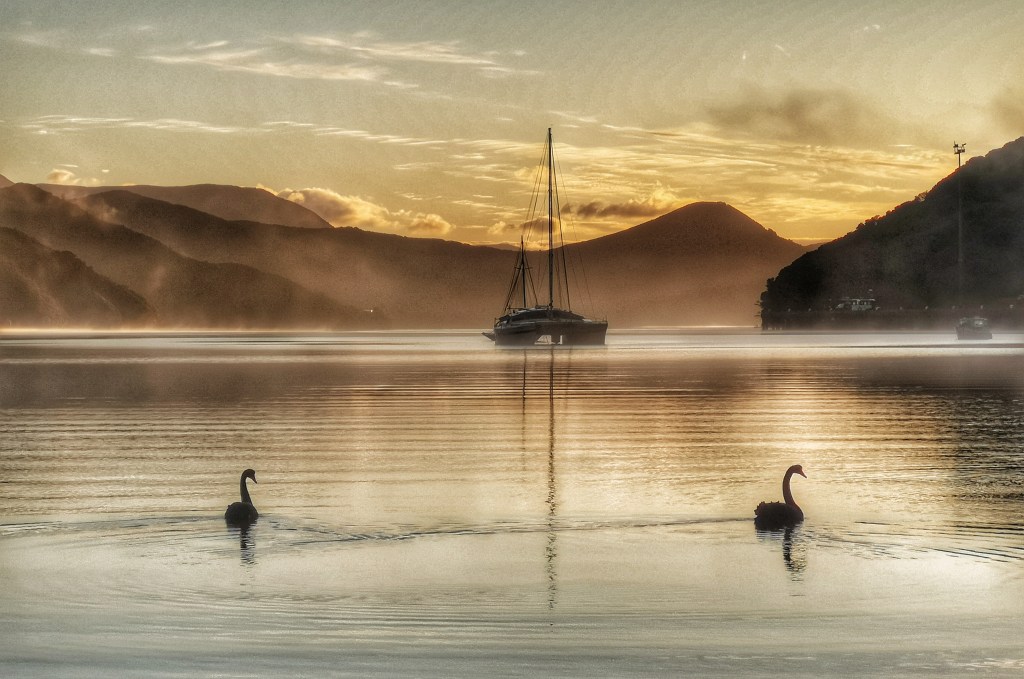
In 1973, part of Kaipupu Point was made into a scenic reserve, and eventually, the land management was given to the Department of Conservation. The point retains some remnants of the original forest, mostly a mix of beech and tawa. In 2005, the land was loaned to the community to create a wildlife sanctuary, and in 2008, a 600-metre-long predator-proof fence was built.
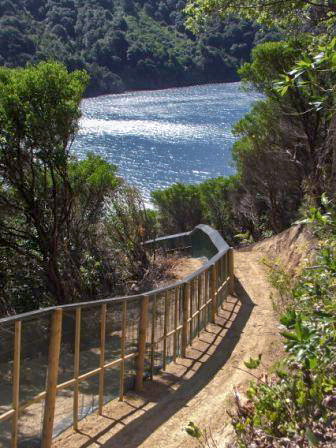
A circular walking track was completed in February 2013, and Kaipupu Wildlife Sanctuary was officially opened to the public in March 2013. It’s a 1.6-mile loop trail and is generally considered an easy route. If walking isn’t your thing, visiting by vehicle or boat to enjoy the scenery won’t disappoint.


Beautiful photos Suzanne. Although it was, and probably still is, common practice in some places around the world it made me shiver to think about waste being dumped into the water, especially when you said the water sometimes turned pink.
LikeLiked by 1 person
Thanks Margaret it is a beautiful area. Luckily those in the know have learnt with research and knowledge to change bad environmental practices. Thank goodness we have the land mass to create sanctuaries.
LikeLiked by 1 person
I don’t expect ever to visit New Zealand, but I know I would love it if I did.
LikeLiked by 1 person
Yes, it’s a long journey to visit NZ. I am sure you both would love it. Luckily for some of us, we can enjoy reading a personal insight into others’ backyards via books and blogs..
LikeLiked by 1 person
Nice to see land being reclaimed for wildlife. Love the rainbow, and the tranquil moment is a stunner.
LikeLiked by 1 person
Isn’t it wonderful that Marlborough has that sanctuary to enjoy. They are very fortunate to have the land mass to do it without needing housing development in that area. Too remote for a starter and I hope NZ never gets that over populated.
LikeLiked by 1 person
The photos here are absolutely incredible, Suzanne. You can leave me there on a stormy night any time you like.
LikeLiked by 1 person
Thanks Jo and I love a good storm preferably from the comfort of indoors. Having said that walking in the rain isn’t too bad if I’ve got the right gear on. No wind and sun made my 14km walk this morning too warm. No pleasing some people 😉
LikeLike
I know that feeling! We’re off walking in a little while. Sunny but with a breeze, I think.
LikeLiked by 1 person
I hope you had a good walk with a breeze.
LikeLike
Absolutely beautiful Spring flowers! An unexpected shower sent us scurrying towards the village where we started. All was well after coffee and cake.
LikeLiked by 1 person
The spring flowers would’ve appreciated the shower. My favourite season Autumn has arrived here.
LikeLiked by 1 person
🤗🍁🩵
LikeLiked by 1 person
Perfectly gorgeous photos. So atmospheric.
LikeLiked by 1 person
Apologies for the late reply, Rebecca. Your comment went into my spam folder, for some weird reason. Thanks, she is a gorgeous place to capture.
LikeLiked by 1 person
Sometimes known bloggers end up in spam. That happens to me several times a year. Usually it’s so reliable.
LikeLiked by 1 person
It’s usually reliable, and I wish they would collect the real spammers who like dozens of posts without reading them.
LikeLiked by 1 person
I completely agree.
LikeLiked by 1 person
Beautiful photos – especially the one of the rainbow and the other of the boat and swans. That last one is definitely frame-worthy.
LikeLiked by 1 person
Marlborough is worth exploring and thanks, Janis.
LikeLike
I reckon I could manage the 1.6 mile loop, and your photos are exquisite, especially the rainbow and the Marlborough Sounds. I would have loved to have done a road trip through NZ but it is probably too late now, so thank you for taking me to these wonderful places.
LikeLiked by 1 person
I must admit, travelling needs plenty of energy to make the most of places. I’m not sure how we did it fulltime for so many years. You have so many choices from your back door 🙂
LikeLiked by 1 person
Incredibly beautiful!
LikeLiked by 1 person
She’s a beauty.
LikeLiked by 1 person
I’m glad they did do something to clean up the water! Ugh. Sure looks beautiful now. Gorgeous photos.
LikeLiked by 1 person
Thanks, Eilene. I suppose back then it was a priority to create jobs and produce food with environmental care taking a back seat. Thankfully, society sometimes learns not all old ways were good.
LikeLiked by 1 person
Yet another magic spot! Ta, Mel
LikeLiked by 1 person
There’s a few and so many walks 😉
LikeLiked by 1 person
Oooo – the temptation! 🙂
LikeLiked by 1 person
Haha, sure 😉
LikeLiked by 1 person
Both interesting and beautiful
LikeLiked by 1 person
Thanks Malc, we have some good memories of camping in the Marlborough Sounds though not that bay.
LikeLike
Interesting history and really good photographs
LikeLiked by 1 person
Thanks, Derrick; the information regarding the history of these small places in NZ sometimes surprises me.
LikeLiked by 1 person
Beautiful picture of Marlborough Sounds Suzanne
LikeLiked by 1 person
She is a beauty, Jim. Did you visit the area on your travels?
LikeLiked by 1 person
No we got as far as Greymouth on the West coast and then headed over to Kaikoura
LikeLiked by 1 person
All worth visiting, and I think it’s better to see just a few and do them justice than pass through too many places while on holiday.
LikeLiked by 1 person
I’m glad to read that this area is being protected, it looks so lovely in your photos (especially the one with a rainbow and the one with the swans!)
LikeLiked by 1 person
The Marlborough Sounds are beautiful if a natural environment is what you are seeking. Sailing around there would be magical. Though there is a wind to watch out for, which is horrendous and the local Conservation officer nicknamed “the freight train”.
LikeLiked by 1 person
I’ve always wanted to visit New Zealand but sadly the flight time makes the dream just a dream. I love the Kaipupu Wildlife Sanctuary photo. Restful
LikeLiked by 1 person
We all need dreams and life is unpredictable and wonderfully weird, so never say never, is my motto.
LikeLike
Beautiful photos. X
LikeLiked by 1 person
Thanks Shazza, she’s a beautiful place x
LikeLiked by 1 person
Thanks for the trip down memory lane. Even though I was a long-time resident of the Marlborough Sounds, I didn’t know much of that history.
We gave up on fighting to get the road fixed and moved into Blenheim. I enjoyed that Kaipupu loop track though. Stunning photos.
LikeLiked by 1 person
You’re welcome, and thanks for commenting. We enjoyed a few trips into Blenheim. I hope you’re enjoying life there.
LikeLike